SOLVEX®

Tank Sludge Mobilization for Storage Systems

No Emulsification. No Modification. Fully Controlled.

Non-emulsifying operational method for mobilizing hydrocarbons from sludge, slop systems and storage assets using existing infrastructure.

  • No stable emulsions
  • No CAPEX
  • No process modification
  • Works in freshwater, seawater and brine
  • Fully reversible

Mobilization during circulation. Separation after stop.

Restores pumpability. Reduces sludge. Recovers hydrocarbons.

Validated under ASTM D1401 / ASTM D4007.

Designed for Storage Tank Systems

SOLVEX® operates within existing tank and handling infrastructure across storage terminals.

  • Uses existing pumps, lines and circulation
  • No change to process configuration
  • No additional equipment
  • No impact on downstream separation

Operates within normal terminal conditions.

What Happens in the Tank

  • Sludge becomes mobile
  • Hydrocarbons are released from solids
  • Flow is restored or improved
  • Oil phase becomes recoverable

Result

  • Reduced sludge volume
  • Improved pumpability
  • Recoverable hydrocarbons

Mobilization for recovery — not chemical cleaning.

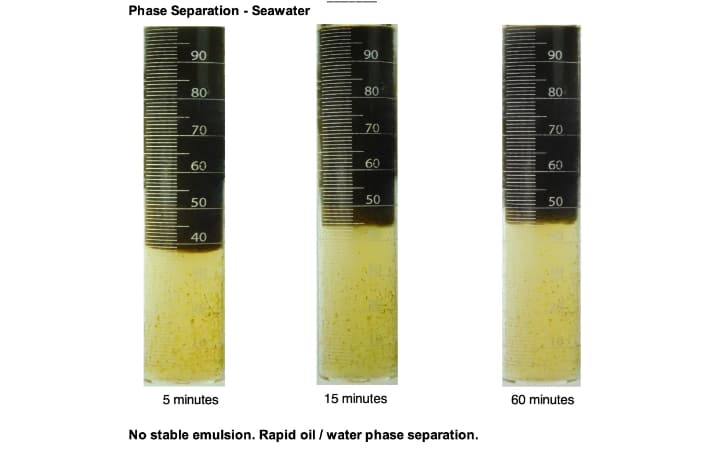
Observed Phase Separation

  • No stable emulsions
  • Clear oil / water / solids layers
  • Recoverable hydrocarbon phase
Observed phase separation in seawater at 5, 15 and 60 minutes.
Seawater system — separation observed at 5, 15 and 60 minutes.
No persistent emulsion formation.

Separation occurs after circulation stops.

Hydrocarbons remain separable under gravity.

Controlled by Circulation

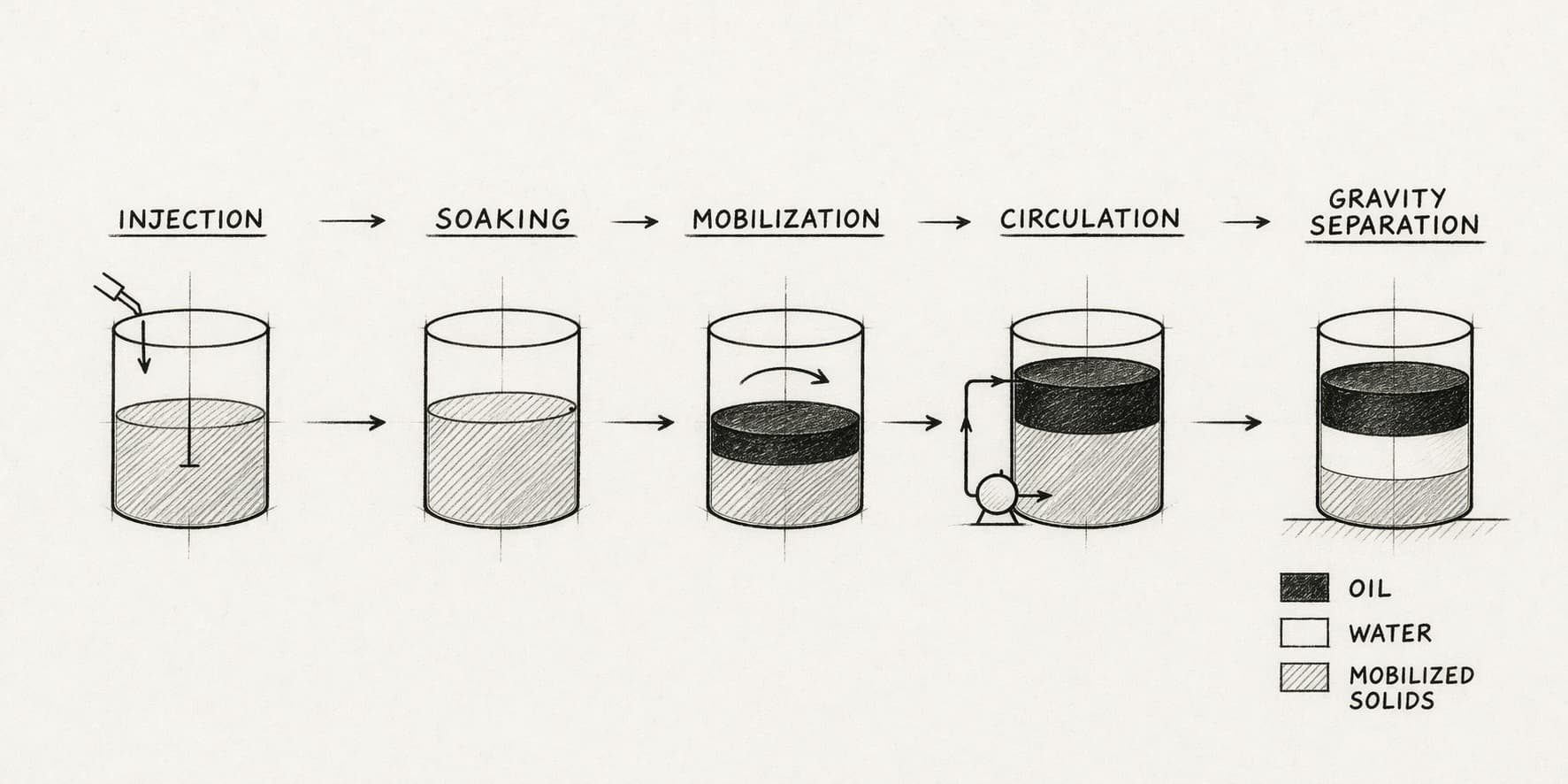
  • Mobilization occurs during circulation
  • Separation starts when circulation stops
  • No persistent emulsions
  • No irreversible effect

Operator control

Stop circulation → system returns to natural separation behaviour.

No circulation → no mobilization.

Operational Effect

  • Releases hydrocarbons from sludge
  • Reduces adhesion to solids
  • Preserves oil / water / solids separation
  • Supports gravity-based recovery

What it avoids

  • No solvent dissolution
  • No stable emulsions
  • No process change
  • No additional equipment

Hydrocarbons are mobilized without loss of phase separation.

Hydrocarbons Accumulate in Storage Systems

Tank bottoms and slop systems contain recoverable hydrocarbons that become operational constraints when flow is lost.

Operational impact

  • Reduced storage capacity
  • Loss of pumpability
  • Increased downtime
  • Higher disposal volumes
  • Increased maintenance burden

These materials are trapped hydrocarbons inside operational systems.

Primary Applications

  • Slop tanks
  • Crude bottoms
  • Transfer systems
  • Storage tanks prior to maintenance

Objective

  • Recover hydrocarbons
  • Restore pumpable conditions
  • Reduce sludge handling volume
  • Improve maintenance readiness

Cleaning hydrocarbons is not the same as recovering hydrocarbons.

Designed for Progressive Deployment

  • Slop tank — initial controlled entry point
  • Storage tank — extension after validation
  • Transfer systems — operational integration

Same principle. Same infrastructure. Larger volume.

Operational Sequence

Figure 2 operational tank sequence.
Figure 2

Execution

  • Uses existing tank systems
  • No shutdown required
  • No modification required

Observed in operation

  • Material becomes easier to move
  • Sludge volume reduces
  • Oil phase separates for handling

Typical Constraints

  • Non-pumpable sludge
  • Accumulated hydrocarbons
  • High disposal volume
  • Limited usable capacity

After application

  • Improved handling
  • Reduced sludge burden
  • Recoverable hydrocarbons
  • Lower operational pressure

Engineering Validation — Core Laboratories (Abu Dhabi)

  • ASTM D1401 — phase separation
  • ASTM D4007 — water content (BS&W)

Observed behaviour

  • No stable emulsions
  • Clear phase separation
  • Low residual water

Crude oil integrity

  • No change in hydrocarbon composition
  • No alteration of crude properties
  • Recovered oil consistent with original phase

Observed in Operational Systems

Nigeria

  • Sludge mobilization observed
  • Oil / water separation observed
  • Recovery of hydrocarbon phase
  • Restored pumpability

Venezuela

  • Heavy crude systems
  • High-viscosity conditions
  • Applicable to difficult environments

Validated in laboratory and field conditions.

SOLVEX® is Not a Cleaning Chemical

  • Not a degreaser
  • Not a dispersant
  • Not a solvent
  • Not a conventional tank cleaning method

SOLVEX® is:

Hydrocarbon Mobilization & Recovery Technology

Cleaning → Waste

Mobilization → Recovery

Deployment Platform — United Arab Emirates

  • UAE-based production
  • CoreLab validation (Abu Dhabi)
  • Regulatory pathway (Montaji)
  • Compatible with operator procedures
  • Aligned with terminal operating conditions

HSE profile

VOC-free • Non-flammable • Non-toxic • Biodegradable

Path to Technical Evaluation

Step 1 — Technical Review

Identify candidate tank or sludge system

Step 2 — Optional Laboratory Confirmation

Testing on operator-specific media if required

Step 3 — Controlled Deployment

Application within existing tank system

Step 4 — Evaluation & Scale-Up

Assessment and expansion within storage systems

Operates within standard terminal conditions.

Start within Existing Tank System

No modification. No disruption. Full control.

SOLVEX®

SOLVEX Industrial Solutions LLC — Abu Dhabi

babinski@solvexflow.com